


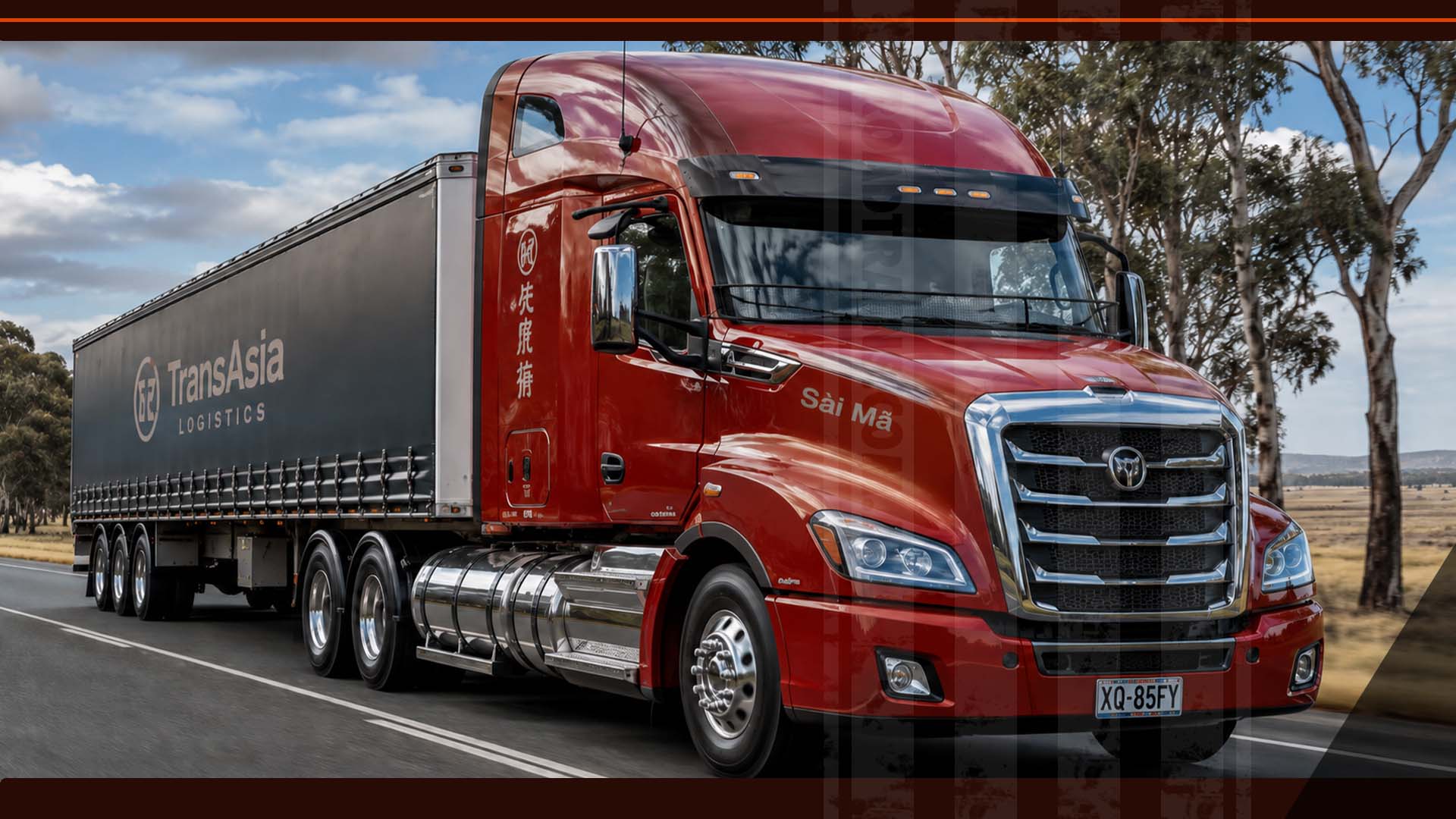


Could a Chinese ‘Temu Kenworth’ challenge PACCAR’s Australian Truck Icon?
Kenworth, and parent company PACCAR, have spent more than half a century building an extraordinary position in Australia’s heavy-duty truck market. But as FAW, Foton and SITRAK improve their products and pricing, could a Chinese manufacturer eventually produce a more affordable alternative to an Australian-built Kenworth T909?

The ultimate test: could a lower-cost Chinese-built conventional one day tackle Australia’s livestock road-train work and challenge the dominance of Kenworth? Artist’s impression.
At first glance, there is something strangely familiar about the truck pictured above.
Long bonnet. Big sleeper. Twin stacks heading skyward. Enough polished metal across the front to momentarily blind a wedge-tailed eagle at half a kilometre.
It looks at home hauling three trailers somewhere west of Longreach, its driver discussing cattle prices, rainfall and the incompetence of whichever government happens to be in office.
Except it isn’t a Kenworth.
In fact, it isn’t anything. Yet!
The truck is our artist’s impression of a hypothetical Chinese-built Australian-style conventional. We’ve called it the Yǒngshì, Mandarin for “warrior”, simply to give our little exercise in crystal-ball gazing a name.
We aren’t aware of any hidden prototypes in Shanghai. There isn’t one sitting on a wharf waiting for ADR approval.
As far as we know, nobody in China is currently wandering around a Kenworth T909 with a tape measure and an unusually large notebook. Truth be told, they’ve already done that.
But after looking at what is happening in the Australian truck market, perhaps the idea isn’t quite as absurd as it would have sounded a decade ago.
Because the Chinese truck manufacturers are coming. Actually, scratch that. They’re already here!

Charlie Hartwig with the Foton Aumark light-duty tipper and FAW J7 prime mover in Canberra—two Chinese truck brands Hartwigs believes are ready to find their feet in regional Australia.
FAW finds an Australian foothold
The catalyst for this particular train of thought is Hartwigs Trucks taking on FAW and Foton across its regional operations.
The significance is slightly more important, more than simply adding another couple of unfamiliar badges to a dealership.
Hartwigs was established in 1923 and is now a fifth-generation family business.
In other words, this isn’t someone who has imported a dozen trucks, rented a shed beside the highway and put three oil filters and a fan belt on a shelf before announcing the creation of a “national parts network”.
Hartwigs has a reputation to protect. And the dealership is putting that reputation behind FAW and Foton with sales, service, parts and factory-backed technical training.
“It’s early days for both the Foton and FAW brands, but the response we have had from our customers within these regions has been genuinely encouraging,” says Hartwigs Dealer Principle, Charlie Hartwig.
That immediately tackles the biggest obstacle Chinese truck manufacturers face in Australia. It isn’t horsepower. Nor is it price. It’s trust.
Australian transport operators can be curious creatures.
We’ll happily point 100 tonnes or more towards a dirt road in 40-degree heat with a thunderstorm brewing over the horizon.
But suggest buying a truck wearing a badge nobody at the pub recognises, even if it is loosely based on a familiar icon and suddenly everyone develops the risk tolerance of an insurance company accountant.
There are perfectly sensible reasons for that.
A cheap truck becomes a remarkably expensive piece of yard furniture when it’s sitting in the workshop waiting three weeks for a $47 electronic sensor.
Australian operators need parts. Not next month. Not when the next container arrives. They always need parts today and preferably before lunch. That is why a century-old regional dealer standing behind FAW is potentially far more significant than another hundred pages of factory specifications.
“We’ve never chased badges for the sake of it,” Charlie continues.

The FAW J7 demonstrator has made a promising early impression among local operators as Hartwigs introduces the heavy-duty model to the Canberra region.
Is the elephant missing a three-pointed star?
Then there is the FAW J7 itself. And we may as well address the rather large elephant parked in the middle of the sales yard.
If it looks surprisingly familiar, you’re not on your own. Put a J7 across the yard from someone who has spent a bit of time around European trucks, and there is more than a passing whiff of Mercedes-Benz Actros about it.
The tall premium cab, windscreen treatment, overall stance and some of the visual proportions are sufficiently familiar to produce the automotive equivalent of déjà vu. You almost expect to climb up into the cabin and discover somebody has put the three-pointed star in the glovebox.
We’re not saying FAW simply photocopied an Actros on a quiet Friday afternoon.
According to FAW, the J7 had international design input, including work from Italian design house Italdesign, so some of its European flavour has a much more legitimate origin than the bloke at a truck show with tape measure and notepad theory.
But the resemblance raises a more interesting point.
For years, one of the easy criticisms of Chinese vehicle manufacturers was that many of their products looked suspiciously like something someone else had already designed.
Increasingly, that argument risks missing what is happening. China doesn’t necessarily need to copy Western design anymore. It can hire it.
Because they can hire international designers. Engage European engineering consultants. Buy components from established global suppliers, most of which are located down the road, in their country. Licence technology. Recruit experienced engineers. Then combine the lot with Chinese manufacturing scale. That is potentially much more threatening to established manufacturers than an obvious knock-off ever was.
And honestly why copy somebody else’s design? Because that will only give you yesterday’s truck. Employing the people capable of designing one gives you the chance to build tomorrows. And one with 660 or 700 plus horsepower.
Whatever anyone thinks about the styling, the J7 being demonstrated by Hartwigs is hardly a little metro delivery truck suffering delusion of grandeur.
We’re talking about a 15.6-litre engine producing 660hp, coupled to a ZF 12-speed automated transmission. That’s enough horsepower to get the attention of most Australian operators before anyone has even reached the price list.
But price is where the conversation becomes particularly interesting.
Chinese manufacturers don’t need their trucks to be dramatically better than the established premium brands.
Initially, they just need to be good enough; and substantially cheaper.
That’s a very different equation.
If the price gap between an emerging Chinese prime mover and a premium established truck stretches well into six figures, operators inevitably start reaching for calculators.
And $100,000 or $150,000 isn’t loose change found beneath the driver’s seat.
It’s a serious deposit on another truck or a trailer and can buy a great deal of diesel. Or, if you’re into blinging up a show truck, approximately four polished stainless accessories and a pair of illuminated mudflaps.

Australian owner-drivers love chrome, custom paint and long bonnets—but could a keenly priced Chinese alternative ever inspire the same loyalty as Kenworth? Artist’s impression.
We’ve already seen how this can happen
FAW isn’t the first Chinese heavy-truck brand to test Australian attitudes.
For that, we need to look at SITRAK.
And SITRAK may turn out to be one of the more important examples in this whole discussion because it has already demonstrated how an unfamiliar Chinese truck can work its way into Australia without directly attacking the most emotionally charged part of the market.
It started making itself visible in construction. Concrete agitators, Tippers and Vocational trucks. In other words, applications in which buying decisions tend to be made with a calculator rather than a tattoo gun.
We’ve previously looked at SITRAK’s emergence in the Australian concrete industry, including trucks working with major operators.
And that is worth paying attention to. Because nobody grows up with a poster of an 8×4 concrete agitator above the bed. There isn’t an eight-year-old somewhere saying: “Dad, when I grow up, I want a mixer with a nine-cubic-metre barrel and optimised front-axle loading.”
Well, there probably is one. But he may require specialist help.
Concrete trucks are overwhelmingly working tools because the fleet manager wants to know:
-
-
- How much does it cost?
- What’s the tare weight?
- How much product will it legally carry?
- What’s the fuel burn?
- Will the drivers accept it?
- Will it stand up to the work?
-
And when it inevitably gets bounced and banged around a building site apparently by concreters, someone inevitably asks can we fix it? That’s a market in which heritage and badge loyalty become considerably less important.

The Foton Aumark light-duty tipper beside Lake Burley Griffin in Canberra, as Hartwigs builds the Chinese truck brand’s presence in regional Australia.
Was the agitator the Trojan horse?
And that question may reveal the cleverest route Chinese manufacturers have found into Australian trucking.
Don’t immediately attack the bloke who has driven Kenworths for 30 years and fully intends to be buried in one.
That would be a waste of ammunition.
The art of market share
Sun Tzu’s The Art of War teaches that the cleverest victory is achieved through strategy rather than a costly frontal assault. Applied to the Australian truck market, the lesson might be simple: don’t take on Kenworth where its emotional defences are strongest.
Start where emotion matters least.
Put concrete agitators into large fleets, where trucks are chosen with spreadsheets rather than sentiment. Then add a few tippers on construction sites. Build workshops, stock the shelves with parts and train technicians to fix them.
Drivers become accustomed to the cab. Fleet managers become accustomed to the invoices. The trucks stop looking quite so foreign.
Then the Chinese manufacturer waits.
One truck reaches 200,000 kilometres. Before long, another passes 500,000. Nothing particularly catastrophic happens. No wheels fall off, the engine doesn’t explode and Western civilisation continues much as before.
The company orders another six.
By now, the workshop knows how to service and repair them. The parts bloke carries the common components. Drivers gradually stop referring to them as “those Chinese things”.
Eventually, somebody utters the most valuable sentence an emerging truck brand can possibly hear:
“You know, they’ve actually been pretty good.”
That statement will sell more trucks than a warehouse full of glossy brochures.
And that is essentially what SITRAK has done.
It hasn’t remained confined to concrete agitators. SITRAKs are now appearing as tippers and prime movers. Horsepower has increased and, importantly, the dealer and service network has grown.
The Trojan horse is already through the gate.
Suddenly, imagining what comes next doesn’t require very much imagination at all.
Could a lower-cost Chinese-built conventional truck like this imagined Sài Mǎ one day challenge PACCAR Australia’s home-grown Kenworth stronghold? Artist’s impression.
Now: Enter the ‘Temu Kenworth’
Which brings us to an expression we’re probably going to regret. “The Temu Kenworth”.
It’s deliberately irreverent. Yet, frankly, increasingly unfair.
Temu suggests ordering a cordless impact wrench for $16.95 and discovering when it arrives that it doesn’t have enough torque to open a stubborn jar of Vegemite.
That’s not really what we’re talking about anymore.
A modern Chinese heavy truck using globally sourced components, international styling expertise, sophisticated electronics and increasingly powerful engines is a long way removed from the old caricature of bargain-basement Chinese manufacturing.
And perhaps that is precisely the bit established manufacturers should be worried about.
The real potential threat isn’t some dreadful imitation of a T909 built from recycled garden sheds. It’s a genuinely competent Chinese interpretation of an Australian truck.
Which brings us back to our fictional Yǒngshì.

Could a Chinese-built conventional combining traditional Australian proportions with aggressive pricing tempt buyers away from PACCAR and Kenworth? Artist’s impression.
Imagine this.
A Chinese manufacturer gives its new conventional a 700hp engine with enough axle-twisting torque to make a driveshaft nervous, then couples it to an 18-speed automated transmission that changes gears rather more competently than an UltraShift having one of its indecisive moments.
It receives Australian-developed cooling capable of coping with 45-degree heat, heavy-duty steer and drive axles, diff locks and cross-locks, a serious suspension package and a proper sleeper cab. It isn’t simply dressed up to look like a road-train truck for the brochure, either; it comes with genuine road-train and heavy-haulage ratings, along with a bullbar sufficiently substantial to alter the future plans of an inattentive Brahman.
Inside, there is adaptive cruise control, autonomous emergency braking, electronic stability control and 360-degree cameras, as well as bunk cooling, a decent fridge and enough USB outlets to recharge every electrical appliance produced since the Nokia 5110.
More importantly, it has been engineered to survive Australian corrugations, while its wiring, plugs and electrical connectors don’t throw in the towel after their first encounter with bulldust. Behind it sits a reputable Australian dealer network, warehouses filled with parts, technicians who have been properly trained and a warranty substantial enough to suggest the importer genuinely believes in what it is selling.
Then comes the number that might cause even the most rusted-on truck buyer to pause: a price perhaps $100,000, $150,000 or even more below that of a comparable premium conventional.
Would anyone buy one? Of course they would. Fleet operators, mining contractors and construction companies would soon reach for their calculators and discover that national pride can become surprisingly flexible when multiplied across 20 trucks.
The traditional owner-driver, however, may prove considerably harder to convince.
The first bloke through the door probably won’t be someone whose grandfather owned a W-model, whose father drove a K100 and whose current T909 has more stainless steel attached to it than the average commercial kitchen. That particular customer may be beyond saving, and, to be fair, probably doesn’t want to be saved.
But truth be told, for many Australian owner-drivers, a Kenworth isn’t merely another item of plant and equipment. It’s personal. The truck gets photographed outside the family home, the kids climb into the driver’s seat, and it receives a Sunday polish more religiously than some people attend church. Eventually, the interior is retrimmed, the lights begin mysteriously multiplying and stainless steel appears in places where Kenworth’s own engineers hadn’t previously realised stainless steel was required.
Meanwhile, money quietly disappears into the truck while the driver’s spouse is repeatedly assured that the latest collection of lights, covers, visors and chrome embellishments was “already on it” when he bought it.
That emotional relationship is one of Kenworth’s greatest assets because it can’t simply be manufactured in China, packed into a shipping container and unloaded at an Australian dealership. Kenworth has spent more than half a century building that loyalty, one truck, one family and one generation at a time.

The badge may be different, but could a Chinese challenger ever develop the emotional pull of Kenworth’s famous bug? Artist’s impression.
Unfortunately, Excel doesn’t care
Not everybody buying trucks is an owner-driver, of course, and accountants tend not to become misty-eyed while staring at a Kenworth bug. They see capital cost, finance repayments, fuel consumption, maintenance, repairs, payload, downtime, whole-of-life costs and residual value. Whether the badge on the grille makes the transport manager feel warm inside is unlikely to receive its own column in the spreadsheet.
If a fleet buying 100 trucks can save even $100,000 on each one, nobody at the board meeting will be discussing the emotional significance of the badge. They’ll be discussing the rather more tangible matter of $10 million.
This is where brand loyalty encounters its natural predator: Excel.
For a large fleet, a Chinese truck doesn’t necessarily have to be beautiful, inspirational or capable of reducing a third-generation truckie to tears at the first bark of the engine. It simply has to make commercial sense; and that is a considerably lower hurdle.
The ultimate test: could a lower-cost Chinese-built conventional one day tackle Australia’s livestock road-train work and challenge the dominance of Kenworth? Artist’s impression.
Kenworth’s moat is deeper than a badge
The Australian-built Kenworth isn’t successful simply because Australians like the badge on the grille. Behind that badge sits decades of local engineering and accumulated knowledge of Australian cooling requirements, combinations, axle loads, suspensions, frame configurations and applications. Kenworth understands these things because it has spent generations working alongside the operators who actually use the trucks.
Then there is the dealer network, the parts supply, the demand for used trucks and the resulting residual values. Drivers know the product, workshops know how to repair it and bodybuilders understand how to mount equipment to it without needing to ring the factory and communicate through an interpreter, three time zones and a bewildering collection of engineering diagrams.
China may be able to manufacture a truck remarkably quickly, but it can’t manufacture that entire support ecosystem overnight. This is why suggestions that Chinese trucks signal the imminent end of the Australian Kenworth are premature; very premature.
You’d probably have better luck standing up at the Alice Springs Road Transport Hall of Fame and announcing that the bar has replaced beer with kombucha.
But China doesn’t need to destroy Kenworth
This may be the most important point in the entire discussion: FAW doesn’t need to become Australia’s biggest heavy-truck brand, SITRAK doesn’t have to outsell Kenworth.
Chinese manufacturers only need to become credible enough to influence buying decisions. They can begin with a few per cent of the market, then add a little more as trucks accumulate kilometres, a second-hand market develops, residual values improve and the dealer network expands. Keep parts on Australian shelves, honour warranties without an argument and get enough operators saying they’ve had a good run, and the market will begin doing the rest.
Eventually, the established manufacturers will find themselves answering a question they haven’t previously had to answer quite so forcefully:
“Why does yours cost so much more?”
That is when things become interesting, because competition doesn’t merely decide which badge ends up on the front of the truck. It influences pricing, standard equipment, warranties, servicing costs, technology and how hard manufacturers work to retain their customers.
Chinese manufacturers don’t have to kill the Australian Kenworth. They merely have to become good enough to make Kenworth, and everybody else, fight harder for the sale.
So, could somebody build the Yǒngshì?
Of course they could. The bonnet isn’t the difficult part, and neither are the chrome stacks, the sleeper or the styling. Give a competent design team photographs of a T909, a Mack Super-Liner and a Western Star, then explain that Australians like long bonnets, enormous sleepers and enough polished metal to interfere with telecommunications satellites, and they’ll soon return with something suitably convincing.
The difficult part lies beneath the paint. It has to be engineered for Australian conditions, supported by people who understand Australian operations and backed by enough parts to keep it earning money. Then somebody has to persuade an operator that this unfamiliar machine is a safe place to invest several hundred thousand dollars and, quite possibly, stake his livelihood.
That will determine whether Chinese trucks remain interesting outsiders or develop into a genuine force in Australian heavy transport.
Our fictional Yǒngshì may remain nothing more than a bit of digital mischief, but the sequence is already beginning to unfold. Chinese-built agitators are working in Australian construction; tippers are appearing in increasing numbers and high-horsepower Chinese prime movers are rolling along the Hume. Major dealerships are also starting to put their reputations behind them, while FAW is demonstrating its 660hp J7 through regional Australia.
Ten years ago, plenty of Australian operators would have laughed at the idea. Today, they’re taking test drives.
Perhaps the real question, then, isn’t whether China could build an Australian-style conventional. That is probably the easy part.
The question is whether Australians would buy a good one.
Twenty years ago, I would have said there wasn’t a chance. Ten years ago, I probably would have laughed. Today, I’d pause before answering.
Give it 700 horsepower, engineer it properly for Australian conditions, put a reputable dealer network behind it and provide a warranty serious enough to suggest the manufacturer intends to remain in the country. Then leave enough change from the established alternative to put a deposit on another trailer.
There will still be plenty of Australians who wouldn’t touch it with a 40-foot container side-loader, but I wouldn’t bet the farm on all of them saying no.
Because somewhere in China, you can almost imagine an engineer studying a photograph of a T909 and thinking:
“That’s a nice truck.”
Then reaching for the calculator.
But for now if you want to test drive a 660 Horsepower J7 FAW give Charlie Hartwig a call and while you’re chatting with him ask to let you know when the new Yǒngshì arrives.

